Rental property ownership in Dallas comes with real financial exposure that most landlords underestimate. Standard homeowners insurance won’t protect your investment, leaving you vulnerable to liability claims and property damage costs that can drain your profits.
We at Brooks Cannon Insurance Group help Dallas landlords understand their protection options and build policies that actually cover their risks. The right coverage makes the difference between a thriving rental business and a financial crisis.
What Landlords Face in Dallas Rental Markets
Tenant Injuries and Liability Gaps
Tenant injuries on your property, property damage beyond normal wear and tear, and liability claims from visitors create real financial exposure that standard homeowners policies explicitly exclude. In Dallas, where the rental market is growing rapidly, more landlords discover this gap too late.
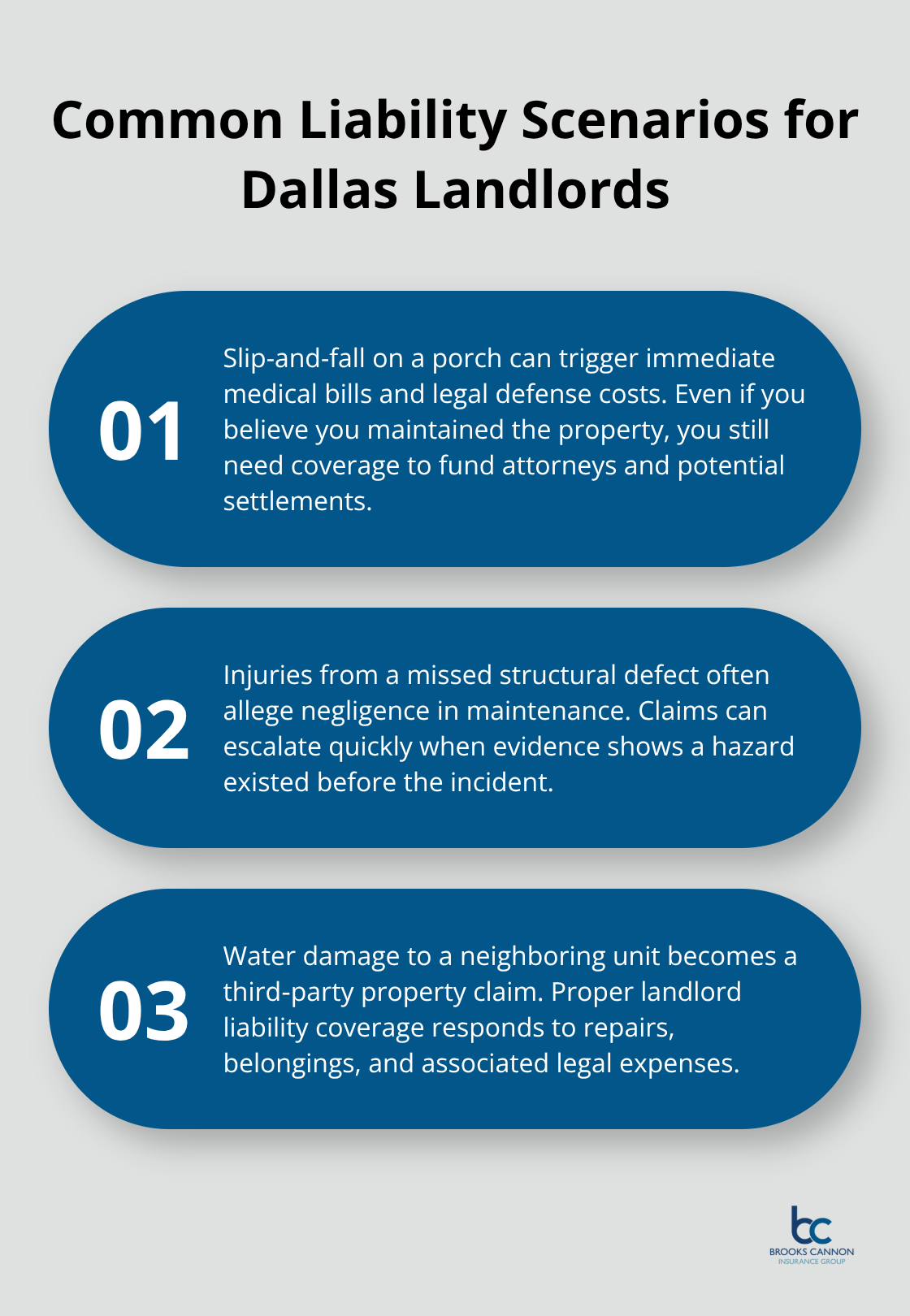
A tenant slips on your porch and sues for $50,000 in medical bills. A guest suffers injury from a structural defect you missed. Your property causes damage to a neighboring unit. Standard homeowners insurance will deny these claims outright because the policy covers only owner-occupied homes, not rental operations.
Your mortgage lender may have required you to carry homeowners insurance on the property before you converted it to a rental, but that policy becomes worthless the moment you rent it out. The liability limits in a homeowners policy typically max out at $300,000, which sounds substantial until you face a serious injury lawsuit. Many Dallas landlords operate for months or years without proper coverage, believing their homeowners policy still applies.
Why Your Current Homeowners Policy Fails
Standard homeowners insurance explicitly excludes rental properties from coverage. The policy you hold was written for owner-occupied dwellings, and insurers will not honor claims related to rental operations. This distinction matters because your exposure changes fundamentally when tenants occupy the property. You no longer control daily maintenance decisions, tenant behavior, or visitor safety in the same way you would in your own home.
Dallas experiences significant hail and wind damage according to local weather patterns, yet your homeowners policy may not adequately protect a rental structure. More importantly, liability claims from tenant injuries or property damage to adjacent units fall completely outside homeowners coverage. If a tenant withholds rent due to unrepaired conditions and later sues you for habitability violations, your liability exposure extends into legal defense costs and potential settlements-costs your homeowners policy will not cover.
Property Damage Versus Liability Protection
Property damage coverage protects the building itself (the roof, walls, plumbing, and structure) when fire, hail, wind, or vandalism strikes. Liability coverage protects you personally when someone is injured on the property or when your property damages someone else’s belongings or structure. These two types of protection serve completely different purposes, yet many landlords confuse them.
A tenant’s guest trips on a loose step and breaks their leg-that is a liability claim. A water leak from your unit damages the tenant’s belongings or the unit below-that is also liability. Landlord insurance bundles both coverages into one policy designed specifically for rental operations, but the liability limits you select matter significantly. Your property’s specific characteristics (tenant volume, property condition, neighborhood profile) should drive your coverage decisions rather than generic industry standards.
Selecting Coverage Limits That Protect Your Net Worth
Liability limits range from $300,000 to $2,000,000 per occurrence, and the right choice depends on your financial exposure. A single serious injury claim can exceed $100,000 in medical costs alone, and jury awards in Texas often run higher. Your coverage limit should reflect not just the property’s value but your personal assets that a judgment could reach.
Dallas landlords who own multiple properties face compounded exposure. A liability claim at one property could affect your ability to operate others if the judgment is large enough. Working with an independent agent helps you evaluate your specific risk profile and select limits that actually protect your net worth. The next section explores the coverage options available to Dallas landlords and how to structure a policy that addresses both property damage and liability exposure.
Building Coverage That Actually Protects Your Rental Income
Understanding the Three Core Components of Landlord Insurance
Landlord insurance in Dallas structures protection around three core components: the building itself, your liability exposure, and your rental income stream. Understanding how each component works prevents you from buying coverage you don’t need while leaving dangerous gaps in place.
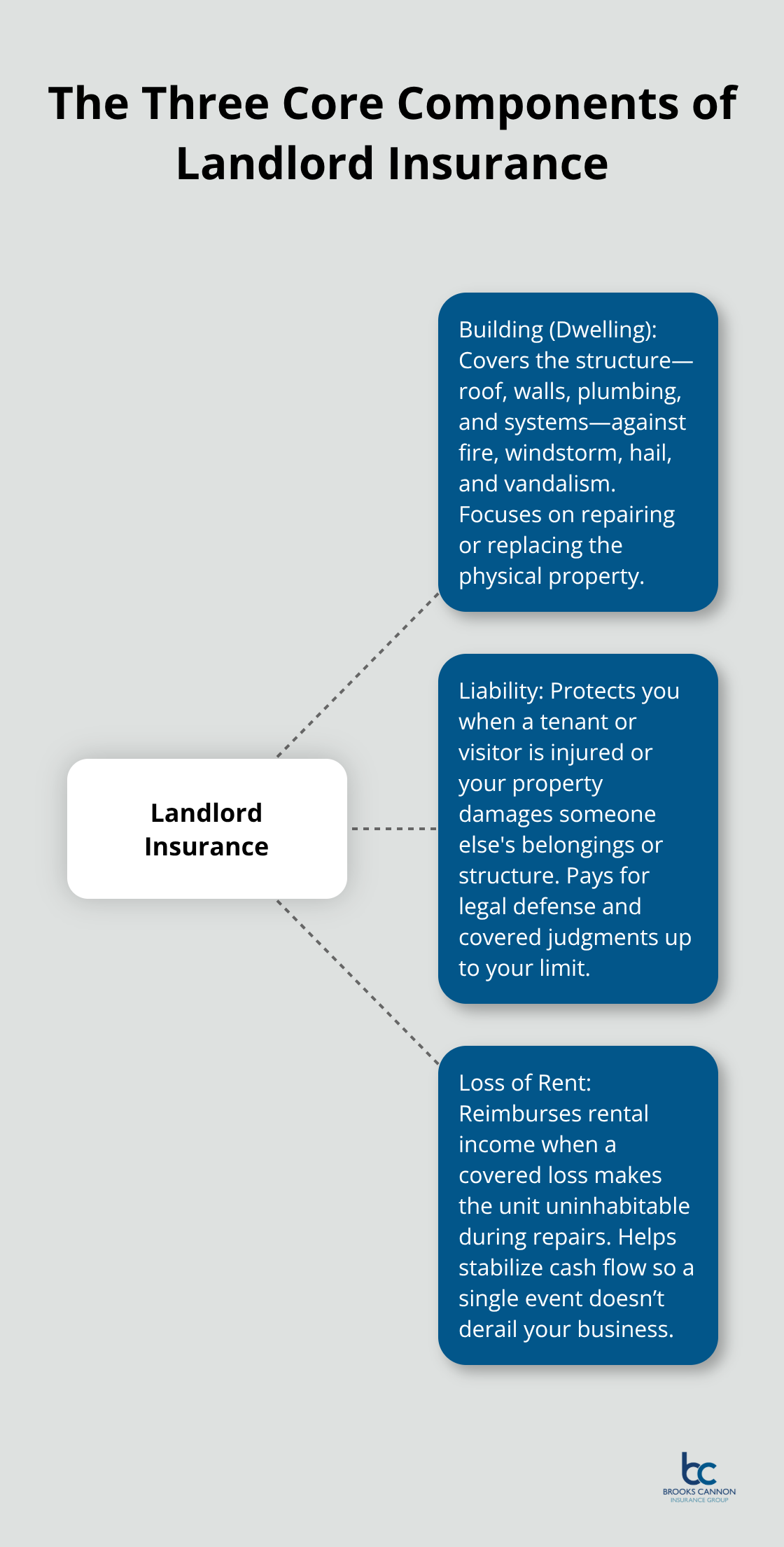
Dwelling fire policies protect the physical structure against fire, windstorm, hail, and vandalism, covering repair or replacement costs when these events damage the roof, walls, plumbing, or electrical systems. This coverage applies to the building only, not tenant belongings or your personal property stored on-site.
Liability Coverage Limits That Match Your Exposure
Liability coverage protects you when a tenant or visitor suffers injury on your property or when your property damages someone else’s structure or possessions. Dallas landlords should carry liability limits between $500,000 and $1,000,000 per occurrence rather than the minimum $300,000, since a single serious injury claim routinely exceeds $100,000 in medical expenses alone. Adding liability protection typically increases your annual premium by about $200 to $400, a modest cost relative to the financial exposure you face.
Loss of Rent Coverage Protects Your Cash Flow
Loss of rent coverage reimburses you when a covered loss makes the unit uninhabitable, replacing your income during repairs so a single event doesn’t disrupt your cash flow for months. This protection matters because a fire, major water damage, or severe storm can force temporary vacancies that last weeks or even months. Without this coverage, you absorb the full income loss while still paying your mortgage, property taxes, and maintenance costs.
Dallas-Specific Risks Require Tailored Coverage
Your policy should reflect Dallas-specific risks rather than generic coverage templates. North Texas experiences frequent hail and high wind damage, so confirm your dwelling coverage includes these perils without exclusions. Water damage coverage matters significantly because burst pipes, appliance failures, and sudden leaks create both repair costs and lost rental income. Storm and hail coverage should explicitly address roof damage, broken windows, and siding replacement since Dallas weather patterns make these claims common.
If your property sits in a flood-prone area, understand that standard landlord policies exclude flood damage entirely, requiring a separate flood policy through the National Flood Insurance Program or private carriers. Riot and civil commotion coverage protects against damage from civil unrest, though you’ll need documentation linking damage directly to the unrest to file a claim. Vacant properties and properties undergoing renovation face heightened theft and vandalism risk, so discuss these situations with your agent before purchase since some carriers restrict coverage during extended vacancies.
Working With an Agent to Identify Your Specific Needs
An independent agent familiar with Dallas neighborhoods can identify which coverages address your specific property’s risks rather than selling you unnecessary add-ons or leaving critical gaps. Your property’s location, condition, tenant profile, and occupancy status all influence which coverages matter most. The next section explores how to evaluate your property’s risk profile and work with an agent to compare carriers that offer the protection your investment actually needs.
How to Match Coverage to Your Property’s Actual Risks
Every Dallas rental property presents a different risk profile, yet many landlords purchase generic policies that either overprotect low-risk properties or leave high-risk ones dangerously exposed. Your property’s location, condition, tenant type, and occupancy status should drive every coverage decision you make. A single-family home in a stable McKinney neighborhood with long-term tenants needs different protection than a multi-unit building in a transitional area with frequent turnover.
Document Your Property’s Specific Characteristics
Start by documenting your property’s specific characteristics: age of the structure, roof condition, proximity to flood-prone areas, neighborhood crime rates, and typical tenant profile. Properties built before 1980 often have outdated electrical or plumbing systems that increase water damage and fire risk, justifying higher dwelling coverage limits and potentially lower deductibles. If your property sits within a flood zone, flood insurance becomes non-negotiable since standard landlord policies exclude water damage from rising water entirely. North Dallas suburbs like Frisco and Plano experience significant hail damage, so confirm that windstorm and hail coverage includes full replacement cost for roof damage, which pays the cost to repair or replace your damaged property without deducting for depreciation.
Compare Carriers Through an Independent Agent
An independent agent representing multiple carriers can show you side-by-side comparisons of coverage options, premium costs, and claim handling records rather than pushing you toward a single insurer. When comparing carriers, you’ll find that liability limits range from $300,000 to $2,000,000 per occurrence, with many Dallas landlords carrying $1 million in coverage to protect their investments adequately. However, comparing carriers means asking specific questions about how each one handles claims in your situation. Does the carrier offer loss of rent coverage that extends long enough to cover repairs if a major event strikes? Will they cover your property during extended vacancies or renovation, or do they restrict coverage in these scenarios? Request references from other Dallas landlords who hold policies with each carrier and ask about their actual claims experience, not just marketing promises. Some carriers process claims faster than others, and speed matters when you need rental income restored quickly.
Identify Coverage Gaps Most Landlords Miss
Most landlords miss coverage for riot and civil commotion damage because they assume it won’t happen to them, yet civil unrest has affected Dallas properties in recent years and can destroy windows, siding, and structural elements. To file a claim, you’ll need documentation proving the damage occurred during civil unrest, so photograph all damage immediately and gather police reports or news coverage linking the incident to the unrest. Ordinance or law coverage gets overlooked constantly, yet this coverage reimburses you when local building codes require you to rebuild to current standards rather than original specifications after a loss. If a fire damages your 30-year-old home, Dallas building codes may require updated electrical systems, improved insulation, or reinforced structural elements that cost substantially more than simple replacement. Without ordinance coverage, you absorb the difference out of pocket.
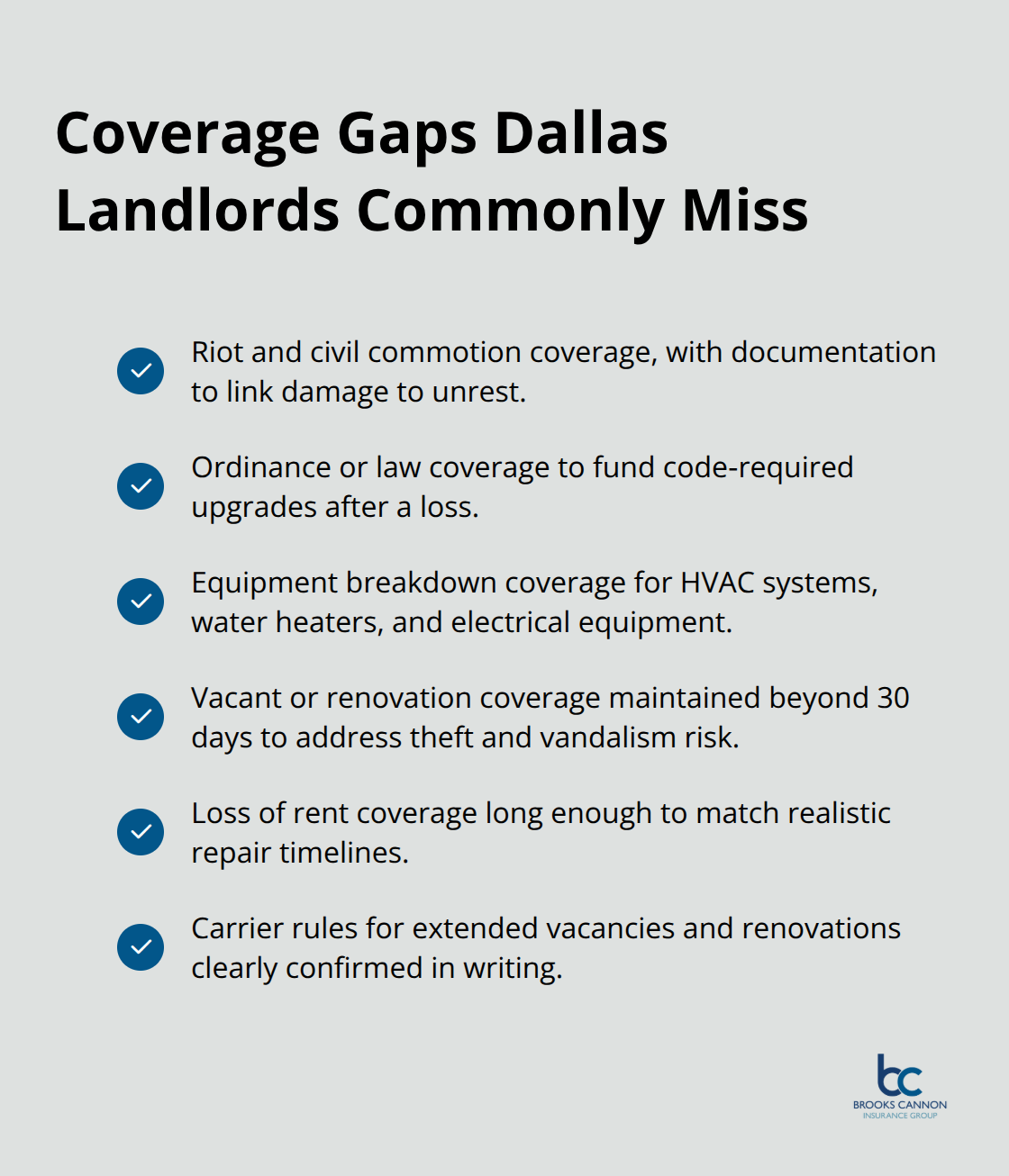
Equipment breakdown coverage protects against mechanical failure of HVAC systems, water heaters, and electrical equipment, which matters more for older properties where these systems approach end-of-life. A water heater failure at a rental property can cost $1,500 to $3,000 in replacement and installation, plus lost rental income if tenants must vacate during repair. When your rental property policy includes vacant property coverage, you protect against the dramatically higher theft and vandalism risk that vacant properties face. If you’re renovating a property or holding it between tenants for more than 30 days, confirm your carrier will maintain full coverage during this period rather than restricting or denying it.
Final Thoughts
Dallas landlord protection options require matching your coverage to the specific risks your property faces rather than accepting generic templates that leave gaps or waste money on unnecessary add-ons. Your rental property’s location, age, tenant profile, and neighborhood all influence which coverages matter most, and selecting liability limits based on actual exposure protects your net worth far better than choosing the cheapest option available. An independent agent familiar with Dallas neighborhoods can identify which protections address your situation and compare carriers that offer the coverage your investment actually needs.
Many Dallas landlords operate with dangerous gaps in their protection because they never questioned whether their old homeowners policy still applied after converting to rental use, or because they selected liability limits based on cost rather than exposure. These mistakes cost thousands when claims arrive, and by that point the damage is done. Working with an agent who represents multiple carriers gives you access to side-by-side comparisons and the expertise to recommend specific protections that address your risks.
We at Brooks Cannon Insurance Group help Dallas landlords build policies that protect their investments rather than leaving them exposed to preventable losses. Our team works with multiple top-rated carriers to find coverage and pricing that matches your unique situation. Contact us today to evaluate your current protection and identify any gaps before a loss forces you to discover them the hard way.
Disclaimer: The information provided in this blog is for general informational purposes only and does not constitute legal, financial, or insurance advice. Coverage options, terms, and availability may vary. Please consult with a licensed professional for advice specific to your situation