
Your homeowners insurance policy likely has a jewelry insurance limit of just $1,500 to $2,500 for all valuables combined. If you own pieces worth significantly more, that gap leaves your collection dangerously exposed.
At Brooks Cannon Insurance Group, we help Dallas residents understand exactly what their current coverage includes and where the holes are. The right protection strategy can make the difference between a full recovery and a devastating loss.
What Your Homeowners Policy Actually Covers for Jewelry
Your homeowners insurance policy covers jewelry under the personal property section, but with significant restrictions that most Dallas residents don’t fully understand until they file a claim. Standard homeowners policies provide coverage for jewelry losses caused by fire, theft, or other named perils listed in your policy. However, this coverage comes with a hard limit-most policies cap jewelry coverage at $1,500 across your entire collection, though some carriers allow up to $2,500. If you own a diamond engagement ring worth $3,000, a vintage watch collection valued at $2,500, and several gold bracelets totaling $1,500, your homeowners policy covers only a fraction of that total value. Property damage, including theft, accounted for 97.8 percent of homeowners insurance claims in 2022, yet jewelry represents one of the most underinsured categories of personal property in American homes.
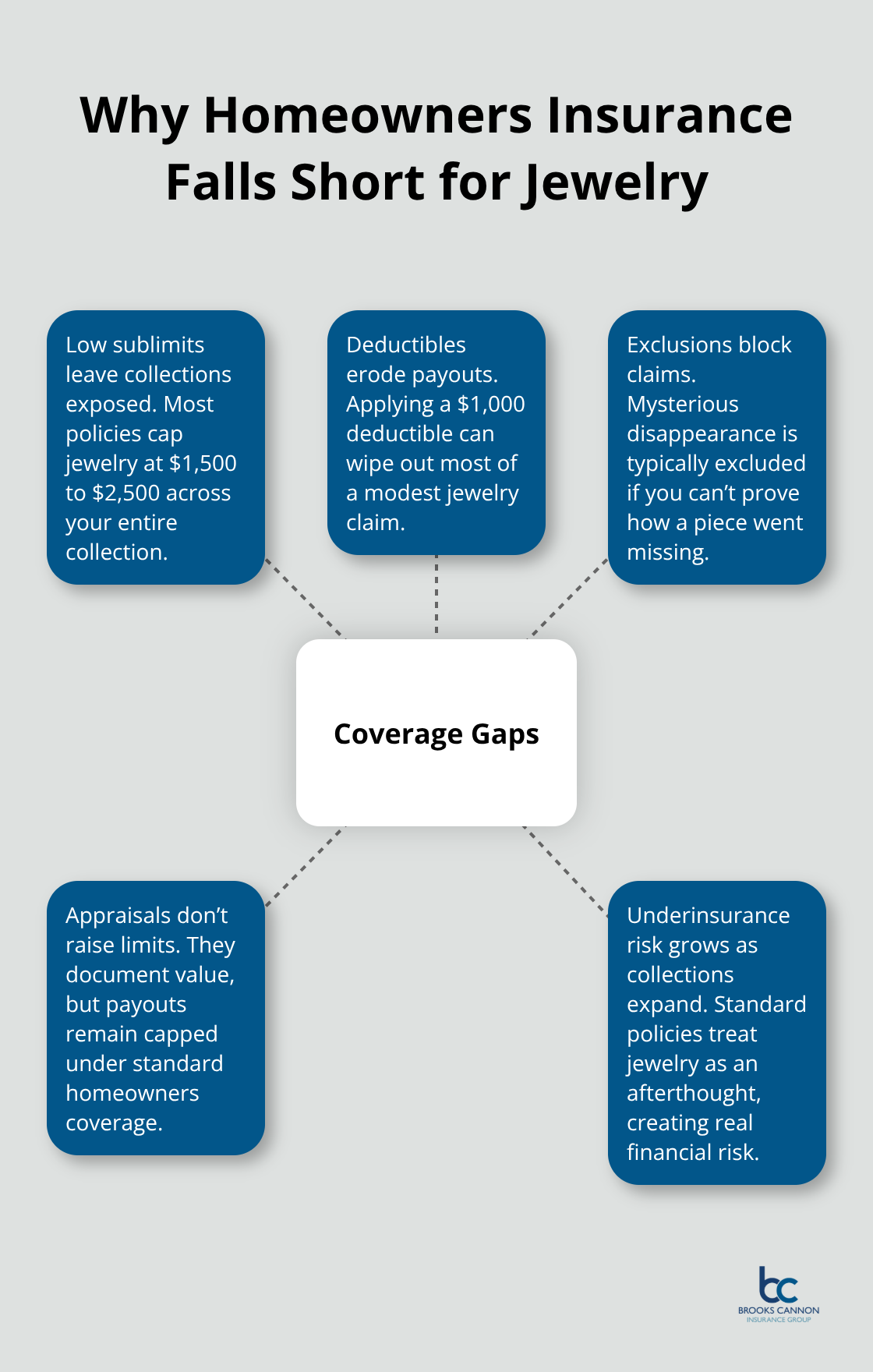
Your homeowners policy typically excludes coverage for mysterious disappearance, meaning if you cannot prove how a piece went missing, your claim gets denied. Many Dallas homeowners discover these gaps only after experiencing a loss, which is far too late.
The Deductible Problem
Your homeowners deductible applies to jewelry claims just like any other claim. If your deductible is $1,000 and your jewelry loss is $1,500, you only recover $500. Some policies require you to pay the deductible per claim, not per item, but this still eats into your recovery significantly. For valuable collections, this deductible structure makes the standard policy nearly worthless. A $2,500 jewelry limit minus a $1,000 deductible leaves only $1,500 in actual coverage, and that’s before the policy’s sublimit kicks in.
Why Appraisals Don’t Help Under Standard Coverage
A professional appraisal documents your pieces’ value for insurance purposes, but it won’t increase your homeowners policy limit. The appraisal sits in your file while the policy limit remains fixed regardless. You could have a $15,000 collection with certified appraisals, and your homeowners policy still pays only up to $1,500 to $2,500. This fundamental flaw forces Dallas residents with valuable collections to pursue additional protection beyond their standard homeowners policy.
What This Means for Your Collection
The math is simple but sobering. Most Dallas homeowners face a coverage gap that grows larger with each piece they add to their collection. Standard homeowners policies treat jewelry as an afterthought rather than a priority asset. This gap between what you own and what your policy covers creates real financial risk. The solution requires looking beyond your standard homeowners policy to options specifically designed for valuable items.
Options for Protecting Your Jewelry Collection
Scheduled Personal Property Endorsements
A scheduled personal property endorsement, sometimes called a floater or rider, attaches directly to your homeowners policy and raises the jewelry limit for specifically listed items. You provide a certified appraisal for each piece, and the insurance company agrees to cover that item at its appraised value with little to no deductible applied. Dallas residents with collections worth $5,000 to $25,000 often find this approach works well because it keeps everything under one policy and typically costs between $1 and $3 per $100 of coverage annually. The catch is that your insurer must approve each piece, and some carriers place restrictions on coverage for certain types of jewelry or require additional security measures. You’ll also need to update appraisals every three to five years as market values change, particularly for diamonds and colored stones that fluctuate with commodity prices.
Standalone Jewelry Insurance Policies
Standalone jewelry insurance policies exist specifically for valuable collections and operate completely separately from your homeowners coverage. These policies typically offer broader protection, covering mysterious disappearance, loss outside your home, and damage from wear and tear that standard homeowners policies exclude.
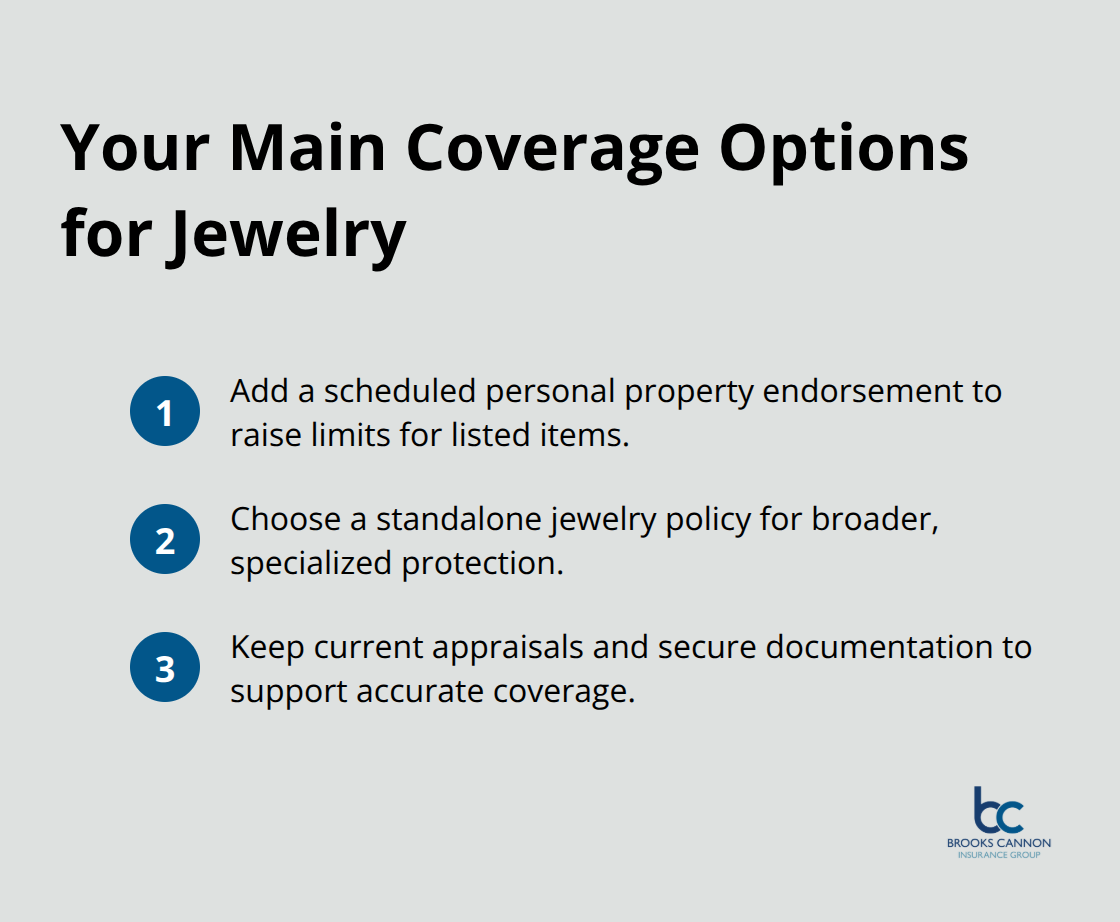
Premiums run higher than endorsements, usually between $3 and $5 per $100 of coverage annually, but the comprehensive protection justifies the cost for serious collectors. An independent agency can access multiple carriers that specialize in jewelry coverage, allowing you to compare actual rates and terms rather than accepting whatever your homeowners insurer offers.
Getting Professional Appraisals
The appraisal requirement remains non-negotiable for either approach, so investing in a certified gemologist or jewelry appraiser becomes your first step. Get appraisals from professionals who hold credentials from the American Society of Appraisers, not from the jeweler selling you the piece, because insurers rightfully question whether a seller’s valuation stays objective. Update these appraisals every three years minimum, and photograph each piece from multiple angles with clear documentation of any distinguishing marks or characteristics.
Storing Your Documentation
Store appraisal documents separately from your home, ideally in a safe deposit box or cloud storage, because losing them during the same event that damages your jewelry creates a second catastrophe. This separation protects your ability to file a claim even if your home suffers a total loss. With your coverage options identified and your documentation in place, the next step involves maximizing what you’ve chosen and finding ways to reduce what you pay for it.
How to Maximize Your Coverage and Lower Premiums
Start with Current Appraisals
Certified appraisals form the foundation of your jewelry insurance strategy, and most Dallas residents treat them as a one-time event rather than an ongoing requirement. The American Society of Appraisers recommends updates every three years, but diamond and colored stone prices fluctuate based on market conditions that shift annually. If you obtained an appraisal in 2023 and prices have risen significantly since then, your current coverage may already fall short of your collection’s actual value.
Request appraisals from gemologists who hold ASA credentials and charge by the hour rather than a percentage of the item’s value. Percentage-based pricing creates an incentive to inflate values, which works against your interests when claims happen. Expect to pay between $75 and $150 per piece for a detailed appraisal that includes photographs, gemstone specifications, and market comparisons. This investment protects you during claims and directly reduces your insurance premiums because insurers base rates on documented values rather than guesswork.
Install Security Systems for Measurable Discounts
Insurers typically offer discounts between 10 and 20 percent when you install home security systems monitored by professional services, and this discount applies directly to your jewelry coverage rates. A safe bolted to your floor or wall that meets Underwriters Laboratories standards often qualifies for an additional 5 to 10 percent reduction because it demonstrates you’re actively preventing theft rather than relying solely on insurance to cover losses.
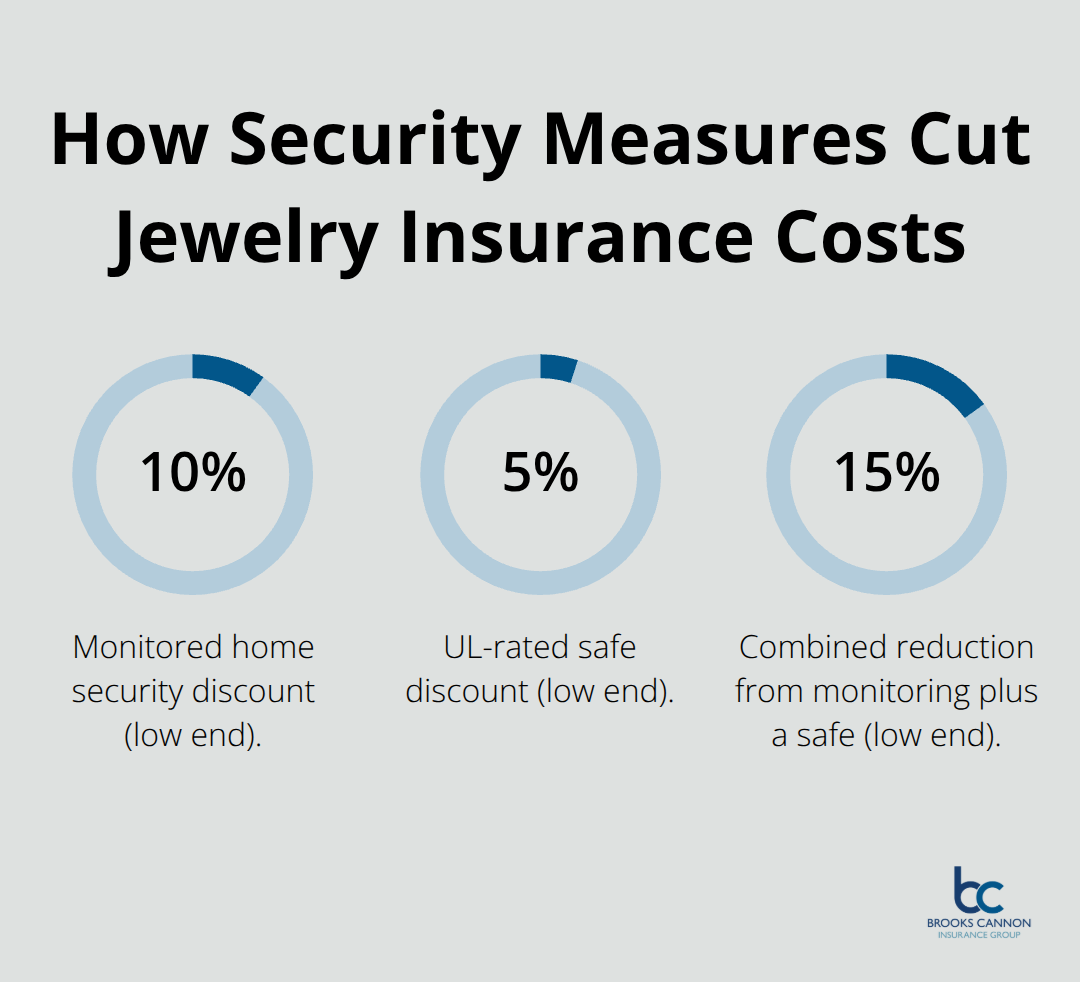
Document your security investments with photographs and receipts, then notify your insurance agent about each upgrade so these discounts get applied to your policy. At Brooks Cannon Insurance Group, we work with multiple carriers to identify which security measures trigger the largest premium reductions for your specific situation. The combination of professional monitoring and a quality safe can reduce your overall jewelry insurance costs by 15 to 30 percent annually.
Review Coverage Annually
Annual coverage reviews matter more than most people realize because your collection likely grows over time, meaning your protection strategy needs adjustment. Schedule a review conversation with your insurance professional each year, particularly after acquiring new pieces or experiencing any changes to your home’s security situation. This yearly conversation ensures your scheduled items remain accurately documented and prevents the coverage gaps that create financial disasters when claims happen.
Final Thoughts
Your homeowners policy leaves your jewelry collection significantly underprotected, and waiting to address this gap until after a loss occurs guarantees financial hardship. Jewelry insurance limits built into standard policies simply don’t match the value most Dallas residents accumulate over time. Whether you choose a scheduled personal property endorsement or a standalone jewelry insurance policy, taking action now prevents the regret that follows a claim denial.
Obtaining certified appraisals from ASA-credentialed gemologists who charge hourly rates rather than percentages forms your first step toward real protection. Installing security measures like monitored alarm systems and quality safes triggers meaningful premium discounts that offset your coverage costs. Committing to annual coverage reviews ensures your protection strategy evolves as your collection grows and market values shift.
Contact Brooks Cannon Insurance Group to discuss your jewelry coverage options and get a clear picture of where your collection stands today. We work with multiple carriers to identify which coverage options and security discounts apply to your specific collection and home situation. As an independent agency based in Dallas, we understand the unique risks Dallas residents face and the coverage gaps that create problems.
Disclaimer: The information provided in this blog is for general informational purposes only and does not constitute legal, financial, or insurance advice. Coverage options, terms, and availability may vary. Please consult with a licensed professional for advice specific to your situation