
One lawsuit can wipe out years of business growth. We at Brooks Cannon Insurance Group see Dallas business owners underestimate their liability exposure every single day.
Your general liability coverage has gaps-and they’re probably bigger than you think. This guide shows you exactly what those gaps are and how to close them.
What Your General Liability Coverage Actually Covers
Bodily Injury and Property Damage Protection
General liability protects you from three major financial threats that can destroy a Dallas business. First, it covers bodily injury claims when someone gets hurt on your property or because of your business operations. A customer slips in your retail store, a delivery person trips on your stairs, or a client suffers an allergic reaction at your salon-these situations fall squarely under bodily injury coverage.
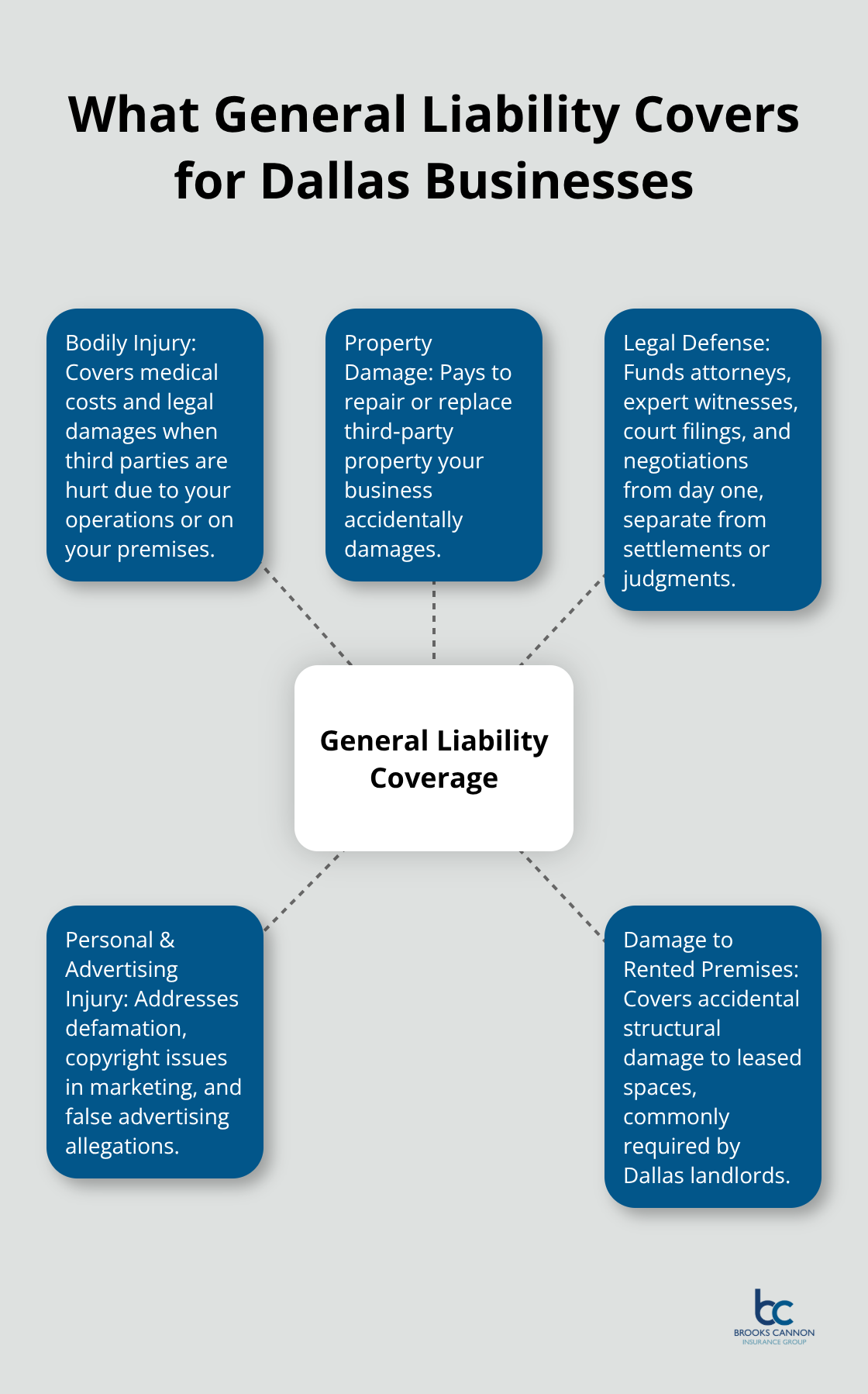
Second, it covers property damage claims when your business damages someone else’s property. You accidentally break a client’s laptop during a service call, your contractor’s equipment damages a rented space, or your delivery vehicle hits a parked car.
Legal Defense Costs from Day One
General liability covers legal defense costs from day one of a claim, which matters enormously in Dallas County. Your policy pays for the attorney, expert witnesses, court filings, and settlement negotiations without waiting for the case to conclude. This protection shields your cash flow when you face a lawsuit, since the insurer handles these expenses separately from any settlement or judgment amount.
Personal, Advertising, and Premises Damage Coverage
General liability also covers personal and advertising injury claims, which protect against defamation, copyright infringement in your marketing, and false advertising allegations. If a competitor claims you stole their business idea or a customer alleges your advertisement made false claims about your product, this coverage handles the legal costs and damages. The policy also covers damage to rented premises-if you’re leasing office space or a retail location and accidentally cause structural damage, your general liability steps in. Many commercial leases in Dallas require you to carry at least $1 million in general liability coverage, and most landlords demand proof through a certificate of insurance before you can occupy the space.
Understanding Coverage Limits and Costs
Your policy limit determines the maximum the insurer will pay, and limits of $1 million per occurrence and $2 million aggregate are standard for most Dallas businesses. Contractors and higher-risk operations often need $2 million per occurrence to meet client requirements. As an independent agency, we at Brooks Cannon Insurance Group work with multiple carriers to match your coverage limits to your actual exposure and contract obligations, rather than applying a one-size-fits-all approach.
Common Liability Gaps Dallas Business Owners Miss
Most Dallas business owners discover their liability gaps only after a claim hits. The problem isn’t that general liability doesn’t exist-it’s that the limits you pick and the exclusions written into your policy create blind spots that grow as your business scales. Dallas County sits among the most litigious markets in Texas, with jury verdicts trending above the statewide average and contested liability defense costs often ranging from $50,000 to $150,000. This reality makes inadequate limits far more expensive than the premium difference between a $1 million and $2 million policy.
Inadequate Coverage Limits for Growing Companies
Growing companies face particular danger here. You might have started with $1 million per occurrence coverage when your revenue was $200,000 annually, but now you’re at $800,000 with five employees and multiple service locations. Your exposure has quadrupled, yet your policy limit hasn’t moved. Contractors face this constantly-general contractors regularly require subcontractors to carry at least $1 million per occurrence as a contract minimum, but many still operate at that floor even though a single serious injury claim can exhaust the limit in weeks.
Professional services firms, architects, engineers, and consultants often carry general liability around $40–$150 per month, but they frequently skip the additional professional liability coverage that protects against client financial harm from mistakes or omissions. Your GL policy excludes those errors entirely.
Exclusions That Leave You Vulnerable
The exclusions hiding in your policy language matter more than most business owners realize. General liability explicitly excludes professional errors, employee injuries, business auto claims, and data breaches. If you’re a consultant providing advice, a salon working on client skin, or any service firm, professional liability must sit alongside your GL policy-GL simply won’t respond when a client claims your work caused them financial harm.
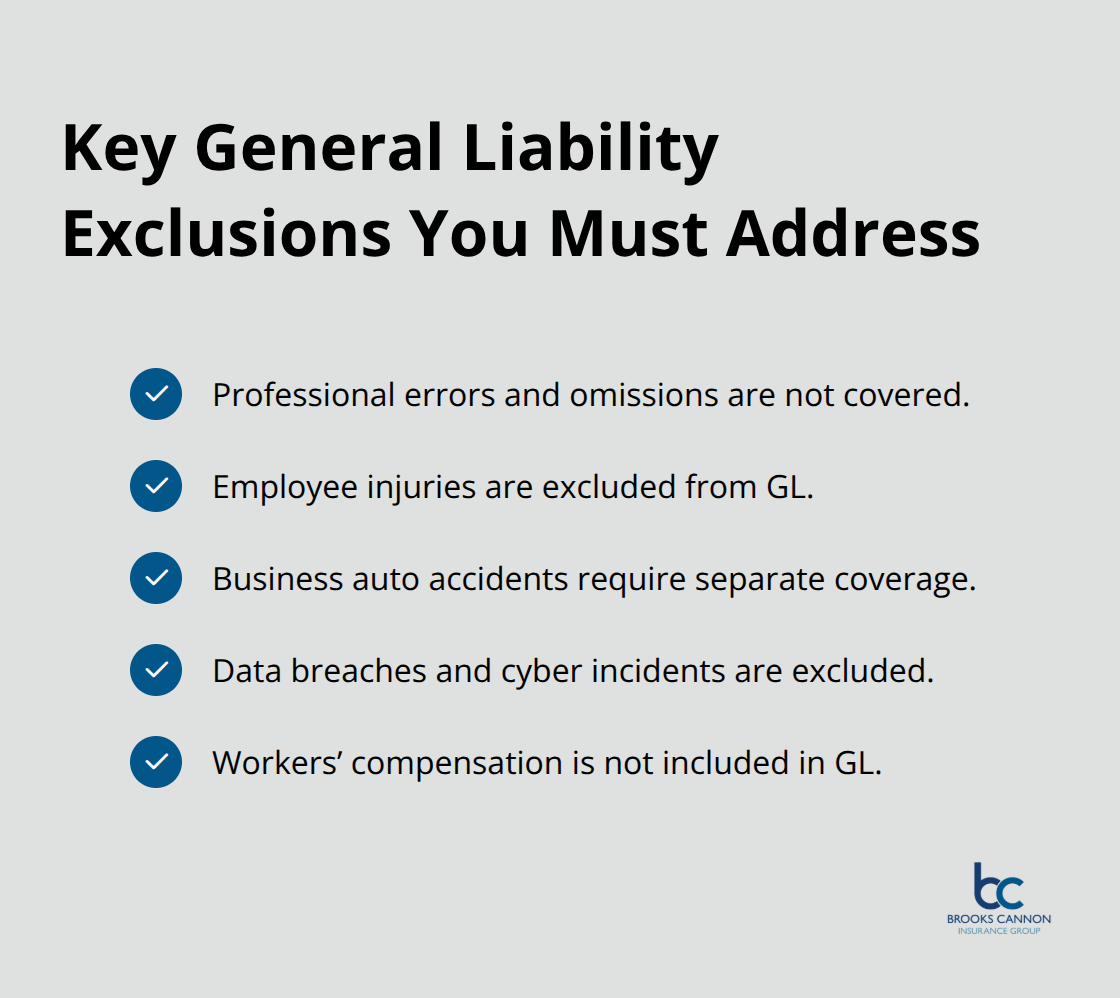
Workers’ compensation isn’t included in GL either, and while Texas doesn’t mandate it for all private employers, operating without it weakens your legal defenses in employee injury lawsuits and leaves you personally liable for medical costs and lost wages.
Underestimating Seasonal or Project-Based Risks
Seasonal businesses and project-based operations create another blind spot. A Dallas landscaping company with heavy activity May through October faces higher exposure during peak months when crews work longer hours and equipment operates continuously, yet they often keep the same limits year-round. Construction firms taking on larger projects should temporarily increase limits for those contracts, but many don’t adjust coverage between jobs.
Commercial leases in Dallas typically require proof of insurance through a certificate of insurance showing specific limit amounts, and if your policy falls below what the lease demands, you’re technically in violation even if you haven’t been sued. The gap between what business owners think they’re protected against and what their policies actually cover typically costs between $20,000 and $100,000 in out-of-pocket expenses when claims materialize.
Closing Gaps Before They Become Expensive
Annual coverage reviews catch these gaps before they become expensive problems. Your limits need alignment with your current revenue, contract obligations, and industry standards rather than letting old decisions dictate your protection. As an independent agency, Brooks Cannon Insurance Group works with multiple carriers to match your coverage to your actual exposure and contract requirements. This approach reveals where your current policy falls short and identifies the specific coverage adjustments that protect your business without overpaying for unnecessary limits.
Strengthening Your Plan Beyond the Basics
Your general liability policy sits on your desk gathering dust until something goes wrong, and by then it’s too late to fix what you should have done months ago. The path forward requires three concrete actions that most Dallas business owners skip entirely. First, stop relying on whatever coverage your previous agent sold you and get an honest assessment of your actual exposure from someone without a preset agenda. Second, treat your policy like a living document that changes as your business scales, not a static contract you signed once and forgot. Third, recognize that bundling isn’t just about saving a few dollars per month-it closes coverage gaps that would otherwise drain your cash reserves in a single claim.
Get an Honest Assessment of Your Actual Exposure
An independent agent looks at your specific operations, your contracts, and your Dallas market position to identify where $1 million in coverage falls short and where you’re paying for limits you’ll never need. This matters because Dallas County contested liability defense costs range from $75,000 to $150,000, which means your coverage limit gets eaten up by legal fees before any settlement or judgment. When you work with an independent agency, you compare options across multiple carriers rather than accepting one insurer’s standard package. A contractor requiring subcontractors to carry $1 million coverage should verify that their own policy matches that standard-yet many don’t. A salon or service business operating from a leased space needs to confirm their limits satisfy the lease requirement, which typically demands $1 million per occurrence and proof through a certificate of insurance. Your agent should pull your lease, review your service contracts, and cross-reference those documents against your current policy limits. If gaps exist, the cost to increase coverage from $1 million to $2 million per occurrence runs roughly $30 to $60 additional per month depending on your industry-a negligible expense compared to the exposure.
Review Your Coverage Annually as Your Business Grows
Annual reviews force this conversation to happen on schedule rather than waiting until you’re already defending a claim. Your revenue grows, you add employees, you take on larger projects, and your exposure shifts accordingly. A policy that protected you adequately at $400,000 revenue provides insufficient limits at $900,000 revenue. Each year, your agent should pull your current policy, compare it against your updated business profile, and recommend adjustments that match your new exposure level. This systematic approach catches gaps before they become expensive problems.
Bundle Coverage to Close Gaps and Save Money
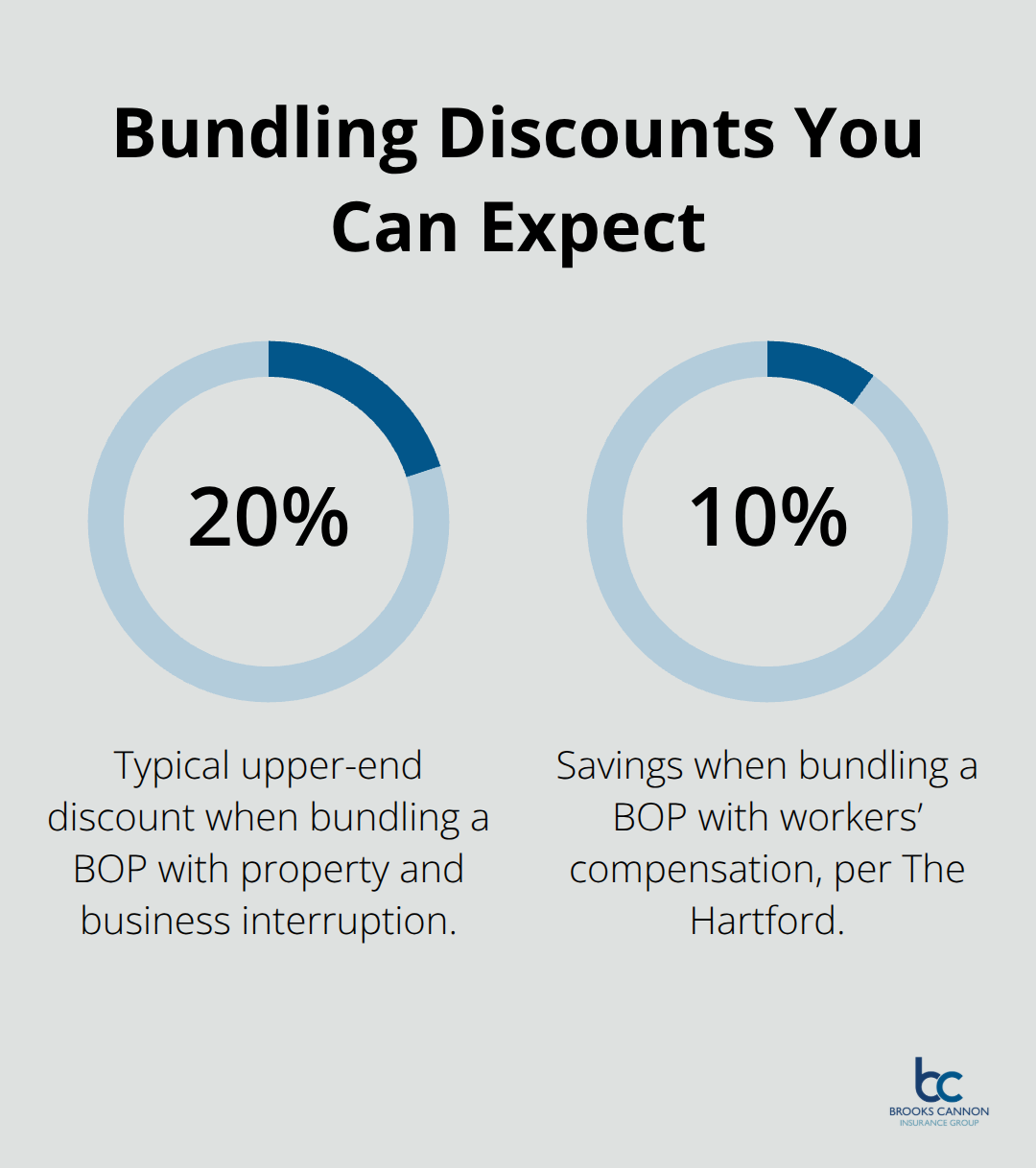
Bundling your general liability with commercial property coverage and business interruption protection through a Business Owner’s Policy yields discounts that typically range from 10 to 20 percent compared to buying coverages separately. The Hartford reports that small business customers bundling a BOP with workers’ compensation save up to 10 percent on their combined premium. This discount structure rewards you for consolidating coverage while simultaneously closing gaps because a BOP includes property protection that pure general liability never provides.
Your leased equipment, inventory, office furniture, and technology all sit unprotected under general liability alone-a fire, theft, or weather event wipes out those assets with zero recovery. Bundling forces a conversation about what you actually own and what you need to protect, which is precisely where most business owners discover they’ve been operating without property protection while thinking their general liability covered everything.
Final Thoughts
General liability insurance protects everything you’ve built, and Dallas County’s litigation environment makes adequate coverage non-negotiable. Jury verdicts trend above the statewide average, and contested liability defense costs routinely consume $50,000 to $150,000 before any settlement gets paid. Without adequate coverage, you risk losing your business to a single claim that exceeds your policy limits.
The gaps we’ve outlined throughout this guide cost real money when claims materialize. Growing companies outgrow their original limits without realizing it, service providers skip professional liability coverage and discover too late that general liability excludes their core business risks, and leased spaces sit unprotected because property coverage never made it into the conversation. Start by pulling your current policy and comparing your limits against your lease requirements, your service contracts, and your current revenue level.
We at Brooks Cannon Insurance Group work with multiple top-rated carriers to build Dallas risk management liability plans that match your actual exposure rather than applying generic solutions. Contact Brooks Cannon Insurance Group for a free coverage review, and we’ll assess your actual exposure and show you exactly what changes strengthen your protection without overpaying for unnecessary limits.
Disclaimer: The information provided in this blog is for general informational purposes only and does not constitute legal, financial, or insurance advice. Coverage options, terms, and availability may vary. Please consult with a licensed professional for advice specific to your situation