
Many small business owners in Dallas operate with insurance gaps they don’t even know exist. These liability gaps can expose your company to financial disaster when a claim hits.
At Brooks Cannon Insurance Group, we’ve seen firsthand how businesses overlook critical coverage areas. The good news is that identifying and closing these gaps is straightforward once you know what to look for.
Three Coverage Mistakes That Cost Dallas Businesses Thousands
General Liability Limits That Fall Short
Your general liability policy might look solid on paper, but standard limits often fail when reality hits. Most Dallas small businesses start with $1 million per occurrence and $2 million aggregate because that’s what sounds reasonable. The problem is that a single bodily injury claim from a customer accident can easily exceed $500,000 in medical costs and legal fees. If your limits sit at $1 million and the judgment lands at $1.2 million, you’re personally liable for that $200,000 gap. Business owners assume their policy covers everything only to discover that their actual exposure far outpaced their limits. For contractors, salon owners, and service providers in Dallas, raising your general liability limits to $2 million per occurrence should be the minimum, not the exception. The cost difference between a $1 million and $2 million policy is surprisingly small-often just $15 to $25 per month-yet the protection gap is enormous.
Professional Liability Blindness
Professional liability insurance is where most Dallas service providers go completely blind. If you offer any advice, guidance, or specialized services-whether that’s accounting, consulting, real estate, design, or technology support-you need errors and omissions coverage. A real estate agent who provides inaccurate property information, a consultant who gives faulty business advice, or a designer who misinterprets client specifications faces lawsuits that general liability won’t touch. Professional liability claims can cost $50,000 to $500,000 in defense and settlement costs depending on the severity. Your general liability policy explicitly excludes professional service errors, leaving you exposed. Many Dallas business owners don’t realize this gap exists until a client threatens legal action over something they said or recommended.
Employee and Contractor Liability Exposure
Employee and contractor liability creates another blind spot that catches businesses off guard. If an employee causes property damage while working at a client’s location or a contractor you hired injures someone, your general liability might not cover it fully-especially if contractual liability requirements exist. Dallas commercial leases and client contracts increasingly demand that you add their company as an additional insured on your policy, and many require specific coverage limits you might not have. Contractor agreements often shift liability responsibility to you, meaning you’re financially responsible for incidents involving subcontractors or temporary workers. Without reviewing these contracts carefully, you could be signing away protections you thought your insurance provided. The next step involves taking a hard look at what your current policy actually covers versus what your business operations actually demand.
Spot Gaps Before They Cost You
Review Your Policy Numbers
Pull out your declarations page and examine three specific numbers: your per-occurrence limit, your aggregate limit, and your deductible. Most Dallas small business owners haven’t looked at these figures since they purchased the policy. Compare what you have against what your industry actually requires. If you run a contracting business, the standard $1 million per occurrence limit leaves you dangerously exposed. Construction-related bodily injury claims regularly exceed $750,000 when medical costs, lost wages, and legal fees stack up.
Benchmark Against Your Market
If you operate a salon or fitness facility, customer slip-and-fall claims can hit $500,000 just from emergency surgery and rehabilitation. A quick way to assess your position is to call three competitors in your market and ask what their general liability limits are. Most will tell you because this information isn’t confidential. If everyone around you carries $2 million per occurrence and you’re sitting at $1 million, you’ve found your first gap. The cost to bump up to $2 million typically runs $15 to $30 more per month, which is negligible compared to the exposure.
Identify Operational Changes
Examine what has changed in your business over the last two years. Did you hire employees? Add a new service line? Start taking on clients in different industries? Each of these operational shifts creates new liability exposures that your original policy might not address. If you brought on contractors or subcontractors, your policy likely does not automatically cover their work unless you specifically added contractual liability endorsements.
Check Your Contract Requirements
Dallas commercial leases and client contracts now routinely require you to name their company as an additional insured, which means you need coverage language in your policy that actually allows this. Review your current contracts with clients and landlords to identify what coverage they demand. If a lease requires $2 million in general liability but you only carry $1 million, that is a gap you need to close before signing. Professional liability is another area where operational changes create blind spots. If you started offering consulting services alongside your main business, or if you’re providing recommendations that clients rely on to make financial decisions, you need errors and omissions coverage.
Recognize Service Line Expansion Risks
Many Dallas business owners add services incrementally without realizing they’ve crossed from general liability territory into professional liability territory. A consultant who gives faulty business advice, a real estate agent who provides inaccurate property information, or a designer who misinterprets client specifications faces lawsuits that general liability will not touch. These professional liability claims can cost $50,000 to $500,000 in defense and settlement costs depending on severity. Your general liability policy explicitly excludes professional service errors, leaving you exposed. The gaps you’ve identified so far point to a larger question: what specific endorsements and additional coverage types would actually close these holes in your protection?
How to Actually Close Your Coverage Gaps
The gaps you’ve identified won’t close themselves, and waiting for a claim to expose them costs money you can’t afford to lose. We at Brooks Cannon Insurance Group work with Dallas business owners to systematically address these exposures using a three-part approach.
Schedule a Policy Audit with an Independent Agent
Start by scheduling an audit with an independent agent who can pull your declarations page and compare it against your actual business operations. This isn’t a sales pitch disguised as a review-it’s a forensic examination of what you carry versus what you need. An independent agent works with multiple top-rated carriers, so they can identify gaps without being locked into one company’s product lineup.
During this audit, your agent asks specific questions about your revenue, number of employees, contractor usage, service lines, and the liability requirements in your commercial leases and client contracts. If you’ve added services, hired staff, or expanded locations in the past two years, your original policy almost certainly doesn’t reflect your current risk profile. If you’ve discovered professional liability exposure, adding errors and omissions coverage runs between $30 and $70 per month for most small businesses. An audit typically takes 30 to 45 minutes and produces a written gap analysis showing you exactly where your coverage falls short and what it costs to fix it.
Add Targeted Endorsements and Coverage Types
Once your agent identifies the gaps, you add specific endorsements and coverage types tailored to your exposures. If your general liability limits are too low, raising them from $1 million to $2 million per occurrence costs roughly $15 to $30 more per month-a trivial expense compared to a $1.2 million judgment. Contractual liability endorsements typically add $10 to $20 monthly and protect you when contracts shift liability your way. If you use contractors or subcontractors, you add them to your policy as additional insureds or obtain their certificates of insurance to prevent coverage gaps when they cause damage.
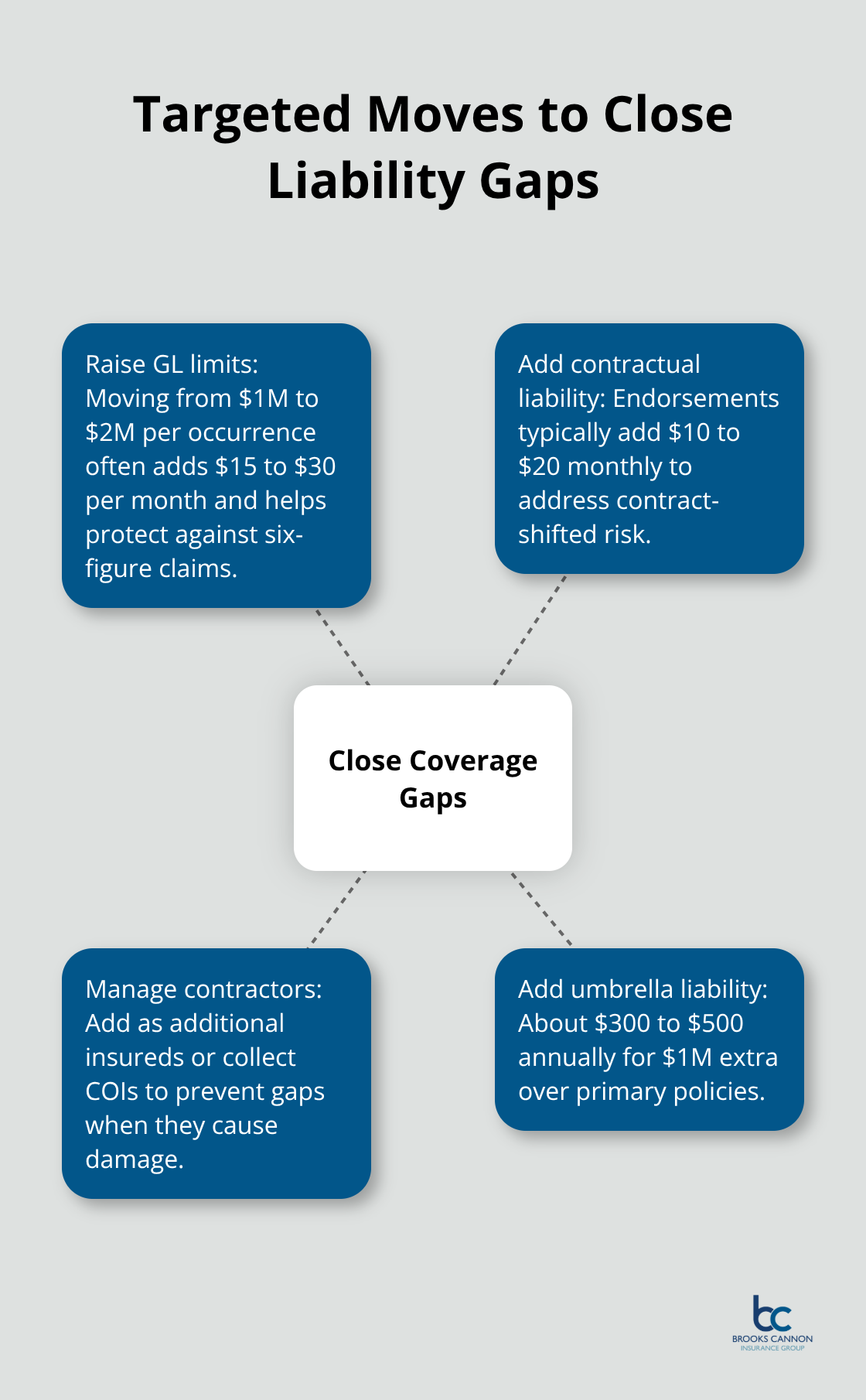
Many Dallas business owners also need umbrella liability coverage, which extends your limits above your primary policies at a cost of roughly $300 to $500 annually for $1 million in extra coverage. The key is not adding random coverages but specifically targeting the gaps your audit identified.
Establish a Formal Review Schedule
After you close these gaps, establish a formal review schedule-at minimum annually, but ideally whenever your business changes significantly. Set a calendar reminder every January to review your policy, or schedule a review whenever you hire your first employee, add a new service line, or sign a major client contract. Business growth creates new exposures, and your insurance must evolve with your company or you’ll find yourself right back where you started: operating with gaps you don’t even know exist.
Final Thoughts
Liability gaps in small business insurance aren’t theoretical problems that happen to other companies-they’re real exposures that cost Dallas business owners thousands of dollars when claims arrive. A single bodily injury claim exceeding your policy limits, a professional negligence lawsuit your general liability won’t cover, or a contractor incident you assumed was protected can wipe out years of profit in legal fees and settlements alone. The gaps we covered (inadequate general liability limits, missing professional liability coverage, and overlooked employee and contractor exposure) represent the most common blind spots we see.
Addressing these coverage weaknesses now, before a claim forces your hand, gives you control over your protection strategy and your budget. Raising general liability limits from $1 million to $2 million costs roughly $15 to $30 monthly, while adding professional liability coverage runs $30 to $70 per month. These incremental expenses pale in comparison to the financial devastation of an uncovered claim, and business owners who close their liability gaps sleep better knowing their assets and payroll are actually protected.
Contact Brooks Cannon Insurance Group to schedule a policy audit with one of our licensed agents. We’ll pull your declarations page, review your business operations and contracts, and produce a written gap analysis showing your specific exposures. Don’t wait for a claim to expose what your insurance doesn’t cover.
Disclaimer: The information provided in this blog is for general informational purposes only and does not constitute legal, financial, or insurance advice. Coverage options, terms, and availability may vary. Please consult with a licensed professional for advice specific to your situation