A data breach can cost a Dallas business an average of $4.45 million, according to IBM’s 2024 Cost of a Data Breach Report. That’s why Dallas cyber risk coverage has become non-negotiable for companies of all sizes.
At Brooks Cannon Insurance Group, we’ve seen firsthand how unprepared businesses are for cyber threats. The right coverage protects your company from financial devastation when attacks happen.
What Cyber Risk Coverage Actually Protects
Cyber risk coverage is a specific insurance product that covers financial losses from data breaches, ransomware attacks, and other digital incidents. It addresses two distinct layers of risk. First-party coverage pays for your own breach response costs, including forensic investigations, notification letters to affected customers, credit monitoring services, and the cost to restore your systems. Third-party liability coverage protects you when someone sues over a breach or when regulators impose fines.
Why Your General Liability Policy Falls Short
Most Dallas business owners assume their general liability policy covers cyber incidents. It does not. General liability covers physical damage and bodily injury, not the digital attacks that now cost Texas companies millions annually. Cyber coverage fills this critical gap and pays for mandatory compliance costs that general policies exclude entirely.
Texas Law Demands Fast Action
The Texas Data Privacy and Security Act, which took effect July 1, 2024, requires businesses to notify affected individuals within 60 days of discovering a breach. If the incident affects 250 or more Texans, you must report it to the Texas Attorney General. Violations result in civil penalties up to $50,000 per violation. Cyber coverage pays these notification expenses and regulatory response costs that can quickly spiral without proper insurance.
Ransomware, Email Fraud, and Vendor Risk
Ransomware remains the dominant threat in the Dallas area. Attackers encrypt your files and demand payment for the decryption key, often while threatening to sell stolen data. Business email compromise, where criminals impersonate executives to trick employees into transferring money or data, costs companies billions annually. Customer data breaches from inadequate security expose your business to lawsuits and regulatory action. Phishing emails that trick staff into downloading malware can shut down operations for days or weeks. Third-party vendor breaches also matter because if your software provider or payment processor is compromised, your customer data may be exposed even though you took precautions.
Small Businesses Are Prime Targets
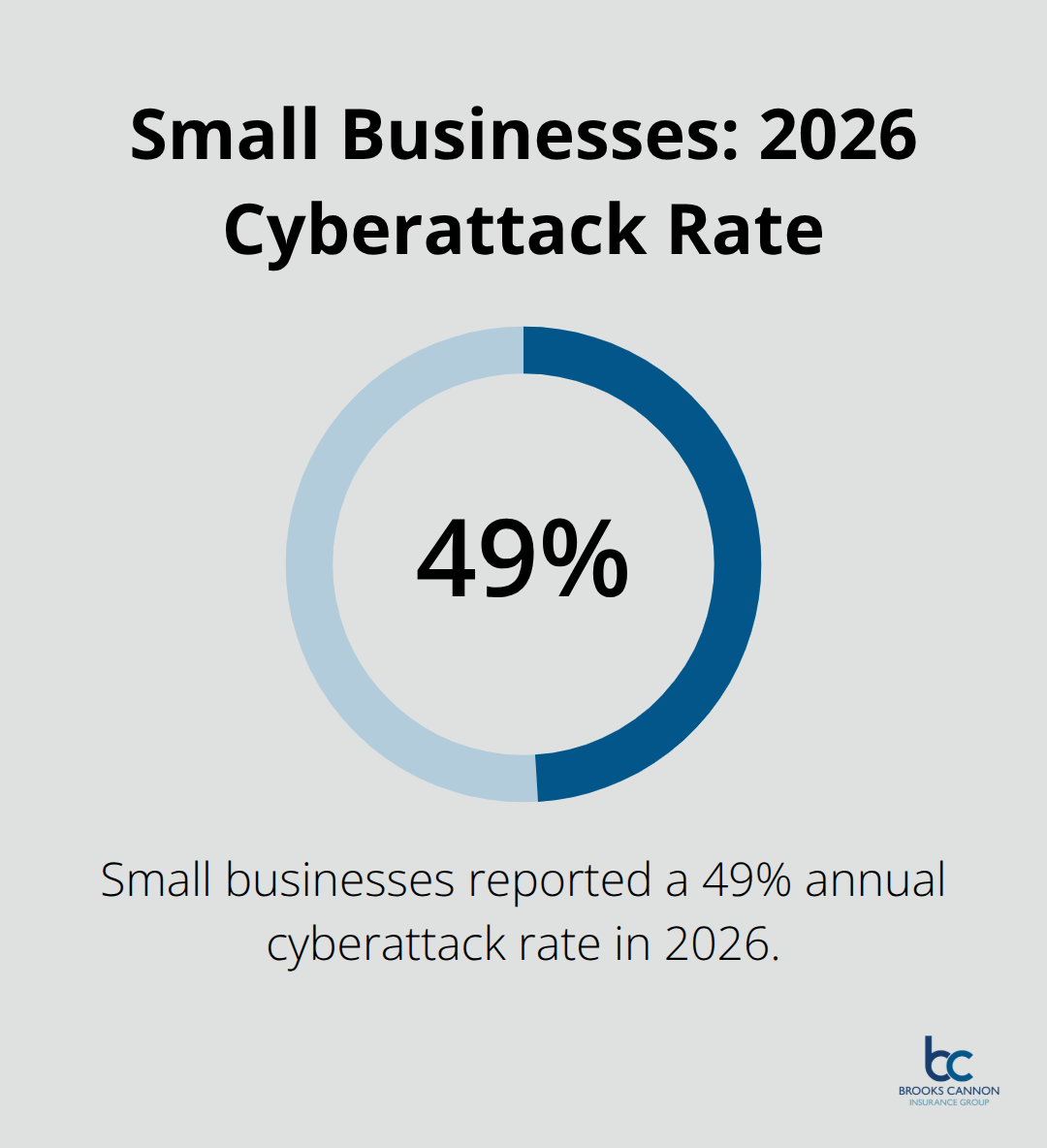
Many Dallas business owners incorrectly believe cyber insurance is only for large corporations or tech companies. Small businesses are prime targets because they typically have weaker security measures than enterprises but still hold valuable customer data and payment information. In 2026, small businesses report a 49% annual cyberattack rate with incidents roughly every 7 seconds.
Any Dallas business accepting credit cards, operating a website, or storing customer information faces meaningful risk and should carry cyber coverage.
Understanding what cyber coverage protects is only half the battle. The next section examines exactly what Dallas cyber policies include and how those protections translate into real financial protection for your business.
Why Cyber Coverage Costs Less Than a Breach
The financial reality is stark: a data breach costs Dallas businesses an average of $4.45 million according to IBM’s 2025 Cost of a Data Breach Report, but cyber insurance premiums start around $25 to $60 per month for very small businesses and scale up to $100 to $250 per month for higher-risk industries like healthcare, legal services, and financial firms. That’s a dramatic difference. When you factor in the Texas Data Privacy and Security Act requirements that took effect July 1, 2024, the math becomes even clearer. Your business must notify affected individuals within 60 days of discovering a breach, and if 250 or more Texans are impacted, you report to the Texas Attorney General. Each violation carries civil penalties up to $50,000. Cyber coverage pays these mandatory notification costs, forensic investigation expenses, credit monitoring services, and regulatory response fees that accumulate rapidly without insurance.
Real Costs From Real Incidents
The City of Dallas experienced this firsthand in 2021 when 20.9 terabytes and 8.26 million files were lost across two separate incidents, according to the City of Dallas ITS 2021 Full Report on Data Loss. The subsequent independent audit by Kirkland & Ellis identified gaps in backup and archive processes, underscoring why restoration costs and data recovery coverage matter so much. A ransomware attack hitting your Dallas business doesn’t just mean paying the extortion demand. It means losing revenue while systems are down, paying incident response teams, hiring forensic experts, notifying customers, managing public relations fallout, and potentially facing regulatory fines if you mishandle the response.
Business Interruption Losses Outpace Ransom Demands
Most Dallas business owners focus on ransomware demands themselves, but the real financial damage comes from downtime. Your employees can’t work, customers can’t reach you, and revenue stops flowing while you recover systems. Cyber policies cover business interruption losses, typically for 180 days or longer depending on your coverage limits, which compensates for lost income during recovery. This protection addresses what many policies exclude: revenue loss beyond the indemnity period and reputational damage. If your Dallas restaurant processes credit cards and suffers a breach, cyber coverage pays to notify your customers, restore your payment systems, and cover lost sales while your operations are compromised. If your law firm’s email system is breached through phishing, coverage pays for forensic investigation, client notification, legal defense if clients sue, and regulatory response costs.
Third-Party Vendor Breaches Create Hidden Liability
Third-party vendor breaches create another layer of liability. If your software provider or payment processor is compromised and your customer data leaks, you face lawsuits and regulatory action even though you took reasonable precautions. Cyber coverage protects against these third-party liability claims, legal defense costs, and settlements that can reach into the millions. Your business depends on vendors and partners who may not maintain the same security standards you do, yet you bear the risk when their systems fail.
Compliance Obligations Drive Coverage Necessity
Texas breach notification law isn’t the only regulatory pressure. The Texas Data Privacy and Security Act added fresh obligations around data protection and handling practices starting July 1, 2024. Businesses must implement reasonable safeguards and respond swiftly to breaches. Cyber policies address the financial side of compliance by covering notification expenses, regulatory investigation costs, and penalties when violations occur. Healthcare providers face HIPAA violations that trigger fines up to $1.5 million per violation category. Legal firms and financial services companies handle sensitive data that regulators scrutinize heavily. Even restaurants and contractors processing customer payments carry meaningful exposure. Cyber coverage protects your bottom line when incidents happen and regulatory demands arrive.
The question shifts now from why you need coverage to what that coverage actually includes and how it translates into protection when your business faces a real attack.
What Your Dallas Cyber Policy Actually Covers
Cyber policies sold in Dallas break down into two distinct payment categories, and understanding which costs fall into each matters more than most business owners realize. First-party coverage pays for your own incident response and recovery expenses when a breach happens to your business. This includes forensic investigations to determine how attackers entered your systems, mandatory notification letters to affected customers, credit monitoring services you provide to those customers for typically one to three years, costs to restore your digital data and systems, business interruption losses while you recover operations, ransom payments if you choose to pay extortion demands, and crisis management or public relations expenses. Third-party coverage protects you from liability when someone else sues over a breach or when regulators impose fines. This layer covers legal defense costs if customers or partners sue, settlements and judgments you owe, regulatory investigation expenses and penalties, and media liability if your online content or advertising creates legal exposure.
How First-Party and Third-Party Coverage Work Together
The distinction between these two layers matters because a Dallas business might have adequate first-party coverage but insufficient third-party limits, leaving you exposed to lawsuits or regulatory fines. When you suffer a ransomware attack, cyber insurance covers the forensic team that investigates which systems were compromised, the notification costs to contact every affected customer as required by Texas data breach notification law requirements, the credit monitoring you must provide, and lost revenue during the recovery period. If a customer sues claiming their data was negligently protected, third-party coverage pays your attorney and any settlement. If the Texas Attorney General investigates your breach response procedures and finds violations, third-party coverage covers regulatory defense costs and potential penalties.
Network Security Liability and Data Restoration
Network security liability and data restoration expenses represent the practical heart of why Dallas businesses actually purchase cyber coverage. When attackers compromise your systems, restoration costs escalate quickly. You need forensic experts to identify exactly what happened, IT professionals to rebuild systems securely, and data recovery specialists to retrieve encrypted or deleted files. These costs easily reach tens of thousands of dollars for small businesses and hundreds of thousands for larger operations. Cyber policies cover these restoration and recovery expenses directly, eliminating the pressure to cut corners on security.
Business Interruption and Extra Expense Coverage
Business interruption coverage compensates for lost revenue while systems are down, typically for 180 days or longer depending on your policy limits. A Dallas dental practice losing access to patient records, appointment systems, and billing software loses revenue immediately, and cyber coverage replaces that income during recovery. A contractor unable to access project files, client communications, and accounting systems falls behind schedule and loses billable hours. Policies often include extra expense coverage that pays for temporary workarounds like renting equipment, paying for expedited restoration services, or relocating operations to recover faster.
Learning From Real Incidents
The City of Dallas 2021 data loss incident involving 20.9 terabytes and 8.26 million files demonstrated that restoration complexity extends beyond simple file recovery. The independent Kirkland & Ellis audit identified gaps in backup and archive processes that required systematic improvements. Your cyber policy should cover both immediate recovery costs and the process improvements needed to prevent similar incidents.
Selecting Appropriate Coverage Limits
When selecting coverage limits in Dallas, align them with your actual exposure. Healthcare providers storing patient health information need higher limits than service businesses with minimal data collection. Law firms handling client confidential information need different coverage than restaurants processing credit cards. Most Dallas policies offer occurrence limits starting at $1 million, with aggregate limits matching or exceeding occurrence limits. Higher-risk industries often need $2 million to $5 million in coverage. The premium difference between $1 million and $2 million in limits is modest-typically 15 to 25 percent more monthly cost-making it sensible to purchase adequate limits upfront rather than face coverage shortfalls after an incident.
Final Thoughts
Cyber threats targeting Dallas businesses are real, costly, and accelerating. A data breach averaging $4.45 million in losses far exceeds the modest monthly premiums for Dallas cyber risk coverage, making the financial case straightforward. Your business faces exposure whether you process credit cards, store customer data, operate online, or rely on vendor relationships. The Texas Data Privacy and Security Act requires breach notification within 60 days and reporting to the Texas Attorney General if 250 or more Texans are affected, with penalties reaching $50,000 per violation.
Start by identifying what data your Dallas business collects and stores-customer payment information, health records, employee data, and proprietary information all create exposure. Review your current insurance policies to confirm what gaps exist, as most business owners discover their general liability and business owners policies provide zero cyber protection. Assess your security practices honestly, since carriers reward businesses implementing multi-factor authentication, employee security training, and regular backups with lower premiums.
Work with an independent insurance agent who understands Dallas cyber risks and can compare coverage options across multiple carriers. We at Brooks Cannon Insurance Group help Dallas businesses identify cyber exposure and secure appropriate Dallas cyber liability coverage that aligns with your specific risk profile and budget. Contact us today to assess your cyber risk and get a quote that fits your business needs.
Disclaimer: The information provided in this blog is for general informational purposes only and does not constitute legal, financial, or insurance advice. Coverage options, terms, and availability may vary. Please consult with a licensed professional for advice specific to your situation